Winning

Winning

Are you a Millionaire in the Making?

How to add a few more zeros to your bank balance

5 reasons the dollar will get stronger

Here are five reasons the dollar could get stronger soon

After-hours buzz: Tesla, Cisco, L Brands more

A pedestrian uses a mobile device to photograph the New York Stock Exchange

Welcome to the Report!

New Design, and with available extra services to help you profit

This city is taking on Silicon Valley as a start-up haven

This tech hub is churning out start-ups at a startling rate. The skilled talent pool is a big driver of the trend.

Wednesday, September 17, 2014

How to Trade Stocks Online Trading Primer Part 2. 'Stock Tips'

This is part 2 on a 10 part series about how to trade stocks online. Feel free to email this post to a friend or re-post.

We've all been there. You are at work standing by the water cooler and Dave from Accounting is telling you all about some hot stock. He's standing there blowing hot air at you about how this is going to be the new thing and now is the time to get in on it on the ground floor. You then go home and open your email and you see a few emails touting some stock or another. Maybe you were at a website a year ago that you were kinda impressed with, left your email, and now some guy is emailing you 4 times a week on stocks, filling up your inbox. Or you go to the mail and find a 6 page flyer on a stock that is ready to explode with expert testimony, graphs and charts including descriptions of how this stock is going to be the next big thing with the contracts that it is about to land.
Lets say that you are smart enough to skip all the above. You keep your head above the water and you only engage in smart investment research. You watch Bloomberg. You read the Wall Street Journal. You watch Cramer. (You read articles like this at www.the1045report.com)
And then you realize something: every time you get into a stock based on the recommendation of one of the above resources, the stock seems to start dropping in value. Then when you go back and look at the trade, you notice that there already was a run up in the stock price by the time you got the news to go ahead and buy this stock for whatever reason.

It Comes Down To The Big Boys VS You

In the stock market, information is power. And advance information before the rest of the crowd gets it is ultimate power. Do you think because you saw something on the internet sitting at home in your pajamas that you are one of the first people to see it?
Its human nature to be part of an exclusive group. That's how humans throughout history have gotten a leg up in life, to separate themselves from the rest of the pack and take the best things that life has to offer by being part of that exclusive group that has engineered special access to these things that everyone else does not have access to. Think Harvard, think Skull and Bones at Yale, Think Princeton, congress and the halls of power. Do you think that its any coincidence that men who have served posts at the White House later get cush positions of power as 'honorary' board members at major corporations for millions a year? Its the inside deal, the special deal. The deal allowed for the privileged few, regardless of how you got there.
While it is definite grey area, and maybe even bordering on illegal, people on the stock market floor and major fund players and big fish at financial corporations get the information on things hours before you do, hours before the information shows up on the AP/Reuters wire and it has already been acted upon. As a matter of fact, the big boys are already starting to sell by the time you get the info and are getting in to buy. That's why when you see something hot in the news then turn on your computer to get in, you will see that the stock has already reacted to the news for a while and has already been climbing.
Pros have slowly over the last 50 years been working on information systems that will give them the news first before the rest of the public and the public wires. They see it as, without this advance start, what are we even doing? They see it as a right, not a privilege.

Flat Out Scams

I remember in June 2013 I got a several page brochure/prospectus in the mail called "The Ken Williams Hard Asset Report. It was a slick color multi page folded mailer with charts, graphs and expert opinion pushing a small oil penny stock. Here are some snaps of what I saw when I opened this up:
As you can see the entire purpose of this brochure was to convince you that this oil stock was about to explode and how BP and Exon and Mobil were going to be a part of this and how you do NOT want to miss out on this action because getting in RIGHT NOW was going to make you rich. The magazine claimed it was giving you a rare inside advance tip. So this got you all hot to quickly get your money in POLR before it exploded right? I threw the mailer to the side for about 6 months and forgot all about it, then found it again. I decided, 'hey, lets see what actually ended up happening with this stock.':
The above is POLR for 2013 and 2014. As you can see, the scammers picked POLR as their penny stock that they were going to push, and they got in early, say in Nov 2012 when the stock was worth pennies, and then they got on the phone and started pushing it. They then started a big mailing blitz using mailing lists of people who have previously signed up for stuff on the internet or had previously made a mail purchase of something to do with the stock market. As these scammers were pushing this stock on the phone and sending out mailers, the stock started to rise as people were sold and started buying it. The peak of this stocks price was about the time I got the mailer, then the scammers sold at 5 and 6 dollars per share up from several pennies and made possibly millions, then the price collapsed back down to pennies leaving everyone who got in towards the end holding the bag. Pump and Dump.
This happens with unsolicited emails that pop up in your email from people you don't know pushing stocks or people you don't know calling you on the phone pushing stocks. There were two movies done about this, one called "Boiler Room" and more recently, "The Wolf of Wall Street", which were basically companies that made like call centers pushing crap stocks pumping up the price and making the people working the center rich based on a stock that actually provided no intrinsic value other than temporary hype.
If you are going to follow a stock picking service, follow their picks for a while before putting any money in it. That's the only true way to measure their performance. And don't fall for a sudden switch in services. Follow the specific service that you want, and then when you are satisfied that that service does and will make money, then go ahead. Be careful of your money allocation, and take it slowly.

We are hard wired to follow the crowd

We are all wired to suddenly start running when we are in a crowd and we suddenly see everyone start running. Chances are if everyone moves at once, you will feel an irresistible urge to start running as well. The reason for this is evolution. When we were cavemen and suddenly everyone started running, that usually meant that a natural disaster was suddenly in  progress or a hungry sabre toothed tiger suddenly sprang out of the bush. If you stood around trying to figure out what was going on and why is everyone suddenly running, you would have become lunch. 
So the people that stood around were taken out of the gene pool. And the people that moved as one with the crowd kept there genes in play, eventually coming down to you.
This also manifests in crowd behavior in the markets. When the market is roaring like in the late 1990's, the crowd is all clamoring to buy, people can see no end to the market in sight, it even affects the commentators on all the main cable programs. When the stock market is crashing, people all run to sell, which causes the markets to crash harder, which makes people panic and start selling yet more. This is why the market has implemented trading brakes, or a time out to curb the panic selling in a crash by turning the machines off for a hour, half day or even the rest of the day.

Contrarian Traders trade against the crowd..and make all the money (or a good part of it)

Contrarian Traders make quite a bit of money trading against the crowd because for the most part, the crowd is wrong. For example, Contrarian Traders recognized the house buying frenzy as a bubble in 2003-2004. Credit was too loose. People were buying houses with almost no money down with shady sliding scale financing. Everyone was getting into it. The crowd saw money laying on the table and no one wanted to miss out on it, homes were appreciating so quickly. This was the signal to Contrarians to wait with their cash reserves. When the housing market crashed hard in 2008-2009, the value of these homes plummeted a good 30%+. Then the Contrarians came in with their money and snapped up these discounted properties and when the market bounced back in 2012-2013, the houses re-inflated in price, and the Contrarians sold for a profit.

This same principle can also be done in the stock market, virtually every day with information that is public to everybody. Then why doesn't everyone do it? Because of the siren call of the crowd. People are reactive, looking around for the next trend to pile on, for the next momentum play to get with, 
Contrarians look for several pre set situations that they know people will react to and pre-arrange the deck and sit there and wait like a fisherman for the crowd to predictably react. 

For example, what I do is trade against the crowd in a manner that I covered above using a trading window of 2-3 days to 2 and a half weeks.
With a 2-3 day to 2 and a half week window, you can stack the deck in your favor by going against the crowd.Lets look at some specifics at what I do:

A) 2-3 days:  Go to the Yahoo finance page and look up the Earnings calendar, and look for stocks that report quarterly earnings that day 2-3 days in the future. Now look at their analysts expectations. If they are all low, and in the red, then go to stockcharts.com and check to see if the stock has been steadily climbing in price for the last week and a half leading up to earnings. If it has, and the analysts expectation is crap, and 3 out of the last 4 quarters there has been negative earnings surprises, this means that the crowd is wrong, the stock is going to report bad earnings, and the stock is going to drop. To go against the crowd, I would purchase a stock put on this stock (providing it is optionable) 2 days before it reports, and then the day of its earnings announcement, the stock will most likely drop and the put will jump in price. You then sell the put on the earnings date for a profit. The crowd is almost always wrong, you are profiting by going the opposite way of the crowd.

B) 2-2 and a half weeks: Go to the Yahoo finance and look up the Earnings calendar and go out 2-2 and a half weeks. Go on down the list and look for stocks that have great analysts expectations with numbers that are in the black, and high. Look at their last 4 quarters. If 3 out of the last 4 quarters there has been earning surprises to the upside, then there is a good chance that this stock is going to do the 2 week climb leading up to earnings. Purchase call options at the money either for the current month if at the beginning of the month or the next month out. 2 days before the stock announces, sell your options for a profit after the stock climbed up. You want to sell two days early because trading insiders on the stock room floor start to leak the news out ahead of time and this can manipulate the price of the stock and cause it to start dropping early if the news is bad thus eroding our option price.


In doing the above you will have to analysis the market first by looking at the QQQ charts first to determine which way you think the market is going to be going. If you have analysed that the market is going to be dropping over the next several days, you want to go with option A above. The market will aid your put drop, its like a beach ball (your stock) being carried on the wave of the ocean (the stock market). If you think that the market is going to be going up for the next 2-3 weeks from your analysis of both the daily and the weekly charts for the QQQ (weekly is more for long term forecasting) then use option B above. The market will go up and drag your stock up with it, helping your call option to rise with it.

There are further nuances that I use with the Contrarian method that I will cover in a later post in this series, but serves us here in this capacity to make my point on how to trade with publicly held information without getting stomped by the big boys.
By trading in this Contrarian style, you can constantly make money with publicly available information by setting up your trades ahead of time while not competing with the big boys in the slightest. The big boys will be looking to strip the crowd moving as a whole of their money, they wont be concerned about you moving the wrong way in the crowd. Very few people trade that way.
What kind of money can Contrarian traders make? Look up Contrarian Trading on Wikipedia. You will be surprised at what kind of bank those people make.

Until the next installment of the series,

Mark


Tuesday, September 16, 2014

ANVR did what it was supposed to do: drop

ANVR did what it was supposed to do: drop. And it did so significantly. However, I made the mistake of purchasing the wrong strike price. We are going to hold onto it and hopefully the price will drift down further over the next day or two to see if we can still pull out of this. Observe the options today even after over a 6% drop there is little movement:

Here is the problem. The stock suddenly shot up over 60% yesterday and in doing so, it went way outside the range of any of its strike prices that were previously set for its range by the market makers based on its then current price range.
So looking at this stock and knowing that it was going to drop the next day because the crowd is always wrong about overenthusiastic forward expectations with positive reportings on Phase 2 testing due to the fact that there are still two more phases of testing where the FDA could cancel the drug at anytime, I looked at the options that I had available, which were too far out of the money.
From now on what I am going to do is straight out short stocks where I cant find strike prices that are directly at the money or in the money. Problem solved.
This is a direct example of why you need 20 piles of money. Sometimes things like this happens. Even though I was correct about which way this stock would go today, the execution was inncorrect with the strike price. We will hold for one more day (which is why I went with the Octobers to combat option erosion) and see if this stock drifts down some more.

More to come
Mark

Monday, September 15, 2014

QQQ (Nasdaq) Direction next few days and next few weeks

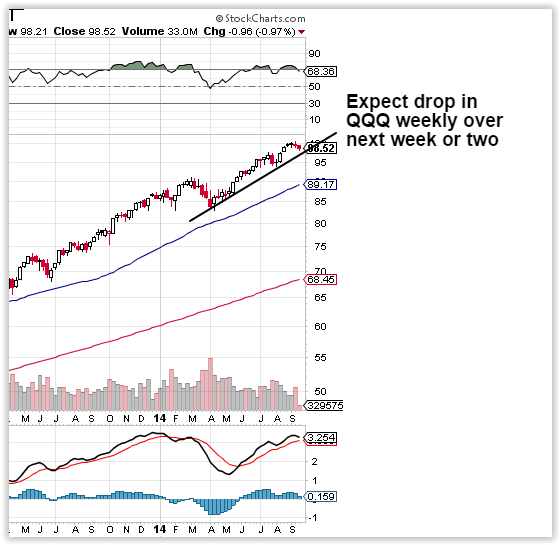
The Nasdaq is undergoing a bit of a pullback. I expect the next few days to be choppy with more to the downside. Looks like down one more day, a bit of an up day, then some consolidating chop. I dont have the exact specifics, but barring any sudden good news in the market, plan your trading to be a bit downward choppy at least until Friday.

As for the longer term, the weekly QQQ is showing that we are going to be down overall for 1 to 2 weeks before the climb resumes.


So how would one use this information? Maybe you are involved in some move in the market and you need to know which way it is likely to move in the next week or two. Perhaps you like purchasing options on the QQQ. Perhaps you like options or puts.
Most importantly of all, I use this information to determine what I will do using my two main systems of either letting a stock climb over the next two weeks to earnings, or purchasing puts on a stock that will report in 2-3 days out. For example, if I expect the market to be climbing in the next week or two, I will look at the earnings schedule for 2.5 weeks out and look for stocks that are expected to crush earnings. I then will purchase a call before most people get into the 2 week pre earnings announcement climb and then sell at the peak, about 1-2 days before the stock reports earnings. If I determine like I did with the above two charts that overall barring any sudden news that the stock market will likely drift downwards, I will look at the stock earnings calendar three days in the future and look for stocks that are expected to have really poor earnings. I then will cross index this with stocks that are erroneously climbing up to their earnings in an incorrect momentum play (this happens all the time for some reason: again the public is often wrong). I then purchase puts and sell them after the stock reports earnings after the stock drops. This of course, barring any freaky earnings report that the stock suddenly comes out with that I find happens less than 8% of the time. But does happen every now and then. However in the long run, I always make money because with the way I trade, I am the casino. I may lose every now and then, but I will always have a skid of money at the end of the year, by breaking up my trades into 20 different piles.

So there you have it, and stay tuned for more informative posts,

Mark

This should be of concern

I have been reading things across the web on how the united states dollar cannot sustain itself under the crushing debt that has recently crossed over 20 trillion dollars under Obama. We apparently are printing billions of dollars per month in order to keep it propped up to prevent a crash. Nixon took us off the gold standard, i.e. he removed the us dollar from backing its value on gold. Since Nixon did this, the dollar is good just because the US says it is, its backed on nothing but the 'full faith of the United States'.
This allowed bankers to loan, loan, loan, and when they needed more money, the Feds just printed more, and this is why there was such large inflation in the 1970's. We just printed more and more money as we needed it and our debt just kept increasing.
Well, there are rumblings of another crash coming, much worse than 2008 or 1929. Its not fun to think about, but perhaps you might be going in the right direction to make preparations for yourself and your family.
Some of the sites on the web describe it like this: You are watching TV. Suddenly a station emergency broadcast cuts in with an anchorman saying that the dollar has collapsed, with intensive coverage. Everyone is shocked. The next day you go to the store, and its almost like a riot, everyone running around clearing the shelves. People driving like maniacs. Day three: Your cable goes out. Day 7: The power and the water to your house goes out. There is no more trucks driving on the road, no one is getting paid. No more food or water in the stores. People dont want useless dollars.
Get the picture? Do you have food and water saved up? Is your home safe from wandering people breaking in looking for food and water? You might want to start thinking about things like this. Below is a link so you can start investigating things for your own:

http://moneymorning.com/ext/articles/rickards/25-year-great-depression.php?iris=252778

Sorry for the buzzkill, but you need to know where this country is heading.

Also don't miss this interview: Very important about impending collapse
http://pro.moneymappress.com/MMRBSSH39/PMMRQ962/?iris=252778&h=true

More updates to come
Mark
Today we are going to purchase puts/Short AVNR: The below article shows how this is only a phase two result and there are two more phases this drug has to go through...I love these because these are easy money.
8:31 am Avanir Pharmaceuticals announces positive Phase II trial results for AVP-923 in treatment of agitation in patients with Alzheimer's disease (AVNR) :
  • Co announced positive results from its phase II clinical trial evaluating the safety and efficacy of AVP-923 for the treatment of agitation in patients with Alzheimer's disease.
  • Treatment with AVP-923 was associated with significantly reduced agitation as measured by the primary endpoint, the agitation/aggression domain score of the neuropsychiatric inventory (NPI) compared to placebo (p=0.00008).
  • The reduction in agitation was observed in both stage 1 (p=0.0002) and stage 2 (p=0.021) of the Sequential Parallel Comparison study design.
  • Significantly Improved Agitation in 220-Patient 10-week Study - - Co Plans to Meet with FDA to Discuss Initiation of Pivotal Development Program.

Sunday, September 14, 2014

How to Trade Stocks Online Trading Primer Part 1. 'DayTrading'

This is part 1 on a 10 part series about how to trade stocks online. Feel free to email this post to a friend or re-post.

DayTrading: The Risks and Dangers Thereof

A Brief History

In the 1950's and 1960's any day trading was done by professionals, and even then with the analogue systems of the day with their order placement it was far from today's daytrading system placing that can be done in one second. Some wealthy individuals went to off room trading centers that were connected to brokers and their boys on the floor from large company trading rooms.
So when somebody was looking to purchase a stock that they've been following they would contact their broker and buy shares in a company. Your average man would typically stay with his buy for a minimum of several months, and a lot of people would invest the old fashioned way: they would just park their money in a stock and forget about it.
My friends grandfather bought several thousand shares of GM in the late 1920's and just sat on it for 50 years. I remember in the 80's he was worth quite a bit of money through his grandparents inheritance. (I hope that he sold it before the GM collapse.). My uncle bought Walgreen stock in the early 70's and he rode out Walgreens' expansion for the next 4 decades and now he has a bit of coin himself.
The Market Makers, or the individual or company the provides liquidity for the trading of a particular stock, sets the buy and sell point of the stock they are working, and they take the difference between the spread of the bid and ask in order to make money for themselves, much like a bookie. In the 1950's and 1960's since people weren't coming in and out of stocks that often, spreads were wide, and market makers were enjoying little competition while working, making a decent living. People would purchase stock and hold it for a year or longer. Funds would purchase stock and hold. And everything was good for the investor and the Marketmakers.

The Internet and the late 1990's-The New Frontier of Daytrading

After a few years of the emergence of the Internet, online trading showed up with companies like E trade, Webstreet and WeathWeb, which allowed traders to maintain their own accounts without brokers, buying and selling themselves. This was the emergence of daytrading. Commissions dropped drastically because there was no full service brokers with having your own online trading account.
People then got the idea that they could trade in and out several times a week, monitoring the internet full time for market activity instead of watching it at the end of the day on the news.
And then people started trading every hour, then every five minutes, then every minute, trying to scalp an eighth of a point or even a sixteenth. 
That unfortunately for everyone, was taking the money right out of the market makers pockets.

The Market Makers Go To War

Suddenly the market makers money machine was being stolen by the thousands of day traders that were sitting around in their basements on their computer trading in and out every few minutes. This is exactly what the market makers were doing for the last 50 years but now due to the change in technology, everyone was doing it. So the market makers decided to do something about it.
You see, the market makers have a secret weapon. They can control the price of the stock. They decide which orders they want to fill by looking at the sitting buy orders and the sitting sell orders. Imagine playing tennis against an opponent that is not only good, but can control the ball midair. You take a swing at the ball with your racket, and the ball controlled by your opponent stops dead, does a figure eight around your racket, and suddenly flies the other way. You can never win against such an opponent. (For the rest of this series, go to www.the1045report.com)
This caused people in the late 90's and early 2000's to lose their nest eggs and they ended up day trading it away. The Market Makers would look down at their order boards and identify traders that they felt were sitting at home trying to scalp fractions of a point by swinging a decent chunk of money in and out several times an hour or even minute by minute. They would fill the traders order and then promptly cause the market to go the wrong way by filling orders contrary to the need of the daytrader via his or her position. This would shake the day trader out of their position and force them to sell and take a loss rather than stay in and take a bigger loss.
This didn't go unnoticed by the media. In the early 2000's many newspapers ran stories of people that cashed in their IRA's, sold their businesses, or borrowed money in order to be a full time daytrader.
And then they promptly over the course of the next several months, lost their money. They lost their money in a rigged game: the market makers were controlling the ball. It was an expensive lesson. 

The Flip Side of the Coin

Some people might say, I'm staying out of the Market
Maker's way, Im just going to buy and hold. Well that is almost taking a pair of dice and rolling them at a dice table: the more time that goes by from the time you make your purchase, the more of a chance chaos will fractal things into several of many possible directions.
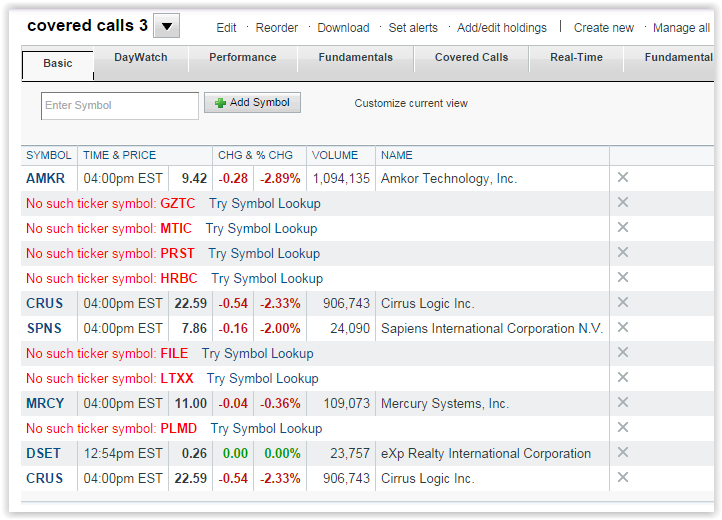
Let me give you an example. In the late 1990's, I was watching and playing with some stocks so I decided to go on yahoo and create three active watch lists. I probably had 10-15 stocks per watch list. They were priced on average from 1 dollar to about 23 dollars for the priciest one. I played with it for about a year, checking them every day, and then when I moved in 2000, I forgot about them. 14 years went by. Then just earlier this year, I was moving around on Yahoo using my handle Tradinginsider that Ive had since 1994 when I first signed up for Yahoo mail, and I stumbled upon these 4 old watch lists that I was using for Covered Call writing in the late 90's when the market kept on climbing and climbing. I found that even after 14 years, they were still active and Yahoo had been updating them daily.  I looked at them fascinated. I marked the lists Covered Calls, Covered Calls 2, Covered Calls 3, and the Dump list. So now its 14 years later, and lets take a look at them and what happened:


As you can see, several things are apparent. First and foremost, there is only one home run that occurred out of the 41 stocks that I had listed. In addition, notice that the one home run, the pharmaceutical company ALXN, was the one I had placed on the above dump list because I didn't think based on its price action that it was going anywhere. Also notice how many of the stocks were no longer in business or had been bought out by other companies: you can see those are now in red where it says "No suck ticker symbol: (XYZ)" all over all 4 of the above watch lists. I mean, without a crystal ball, who knew how this was going to shake out 14 years later? In order to invest or make any money to find that one home run I would have had to place 1 or 2 grand on each one of the 41 stocks back in the late 1990's and spend $41,000 to $82,000 and then forget about the money and leave it parked for 14 years. It was a turkey shoot.
When you are investing long term, a lot of things can go wrong. First, lets look at the Nasdaq from the late 1990's until now. 

If you had gotten in at the late 90's you would have about come out even 14 years later. There were two crashes in the interim and if you had the steel balls not to sell and get your money out during the crash of 2000-2002, you probably would have thrown the hat in and given up during the crash of 2008. Lets say for example that you did leave your money in the market. Could you have stood to come out almost even over the course of 14 years, with inflation eating up your dollars at the rate of 4% a year? This is why 401Ks take a beating in the long term. No one knows where the corrections are going to be and for how long. 
Lots of other things can go wrong when you invest long term. The companies officers could be stealing from the company and keeping two sets of books. This happened with Mercury Finance, and some other big energy companies such as Worldcom and Enron. As a matter of fact, a few of thier officers were taking money and building homes in Florida because the law says in Florida you can't seize a home built there because of a financial or custody court case. Companies can be chugging along and suddenly the market forces can change making their product obsolete, or the officers vision for emerging markets is faulty and the stock drops in price, goes out of business or gets bought out by another company. 
You just don't know without a time machine. Investing in the long term is tough. Warren Buffet can do it. It takes a lot of talent, and a lot of vision. And a time machine. If I had a time machine, I would go back to the early 80's, mow a lot of lawns as a 13 year old, and caddy a lot for a couple of summers. I would then put a few grand in Microsoft in 1986 and sell it in 1999. So, anyone know of a good time machine?

The Big Secret

The best trading window to get around both problems that I covered above is a trading window of 2-3 days to 2 and a half weeks. First of all, you want to avoid the Market Makers territory by trading in and out in the same day. Especially trying to scalp tick by tick. You do that, and the MM will take all of your money. I knew a guy who sold his Pizza shop and scraped together 75 grand and daytraded it away. 
With a 2-3 day to 2 and a half week window, you can stack the deck in your favor by going against the crowd. While I will cover about going against the crowd in a later post, I will cover how to trade using the big secret below using these two time frames:

A) 2-3 days:  Go to the Yahoo finance page and look up the Earnings calendar, and look for stocks that report quarterly earnings that day 2-3 days in the future. Now look at their analysts expectations. If they are all low, and in the red, then go to stockcharts.com and check to see if the stock has been steadily climbing in price for the last week and a half leading up to earnings. If it has, and the analysts expectation is crap, and 3 out of the last 4 quarters there has been negative earnings surprises, this means that the crowd is wrong, the stock is going to report bad earnings, and the stock is going to drop. To go against the crowd, I would purchase a stock put on this stock (providing it is optionable) 2 days before it reports, and then the day of its earnings announcement, the stock will most likely drop and the put will jump in price. You then sell the put on the earnings date for a profit. The crowd is almost always wrong, you are profiting by going the opposite way of the crowd.

B) 2-2 and a half weeks: Go to the Yahoo finance and look up the Earnings calendar and go out 2-2 and a half weeks. Go on down the list and look for stocks that have great analysts expectations with numbers that are in the black, and high. Look at their last 4 quarters. If 3 out of the last 4 quarters there has been earning surprises to the upside, then there is a good chance that this stock is going to do the 2 week climb leading up to earnings. Purchase call options at the money either for the current month if at the beginning of the month or the next month out. 2 days before the stock announces, sell your options for a profit after the stock climbed up. You want to sell two days early because trading insiders on the stock room floor start to leak the news out ahead of time and this can manipulate the price of the stock and cause it to start dropping early if the news is bad thus eroding our option price.


In doing the above you will have to analysis the market first by looking at the QQQ charts first to determine which way you think the market is going to be going. If you have analysed that the market is going to be dropping over the next several days, you want to go with option A above. The market will aid your put drop, its like a beach ball (your stock) being carried on the wave of the ocean (the stock market). If you think that the market is going to be going up for the next 2-3 weeks from your analyzation of both the daily and the weekly charts for the QQQ (weekly is more for long term forecasting) then use option B above. The market will go up and drag your stock up with it, helping your call option to rise with it. 

Now there are several particulars that you want to observe and pay attention to: How to forecast the market using candlesticks on stockcharts.com, things about the analysis's expectations and how to interpret the data ratio comparison to the industry, sector and s+p benchmarks, and other things such as how to maximize profit with the option chain and if to use the same month options or go one month out. All of this will be covered in this Stock Trading Primer 10 part series. 


Mark